Marcus Maeder (CH/IE)
Imeall an chosta
A coastal listening post
Sound Installation
2022 / 2026
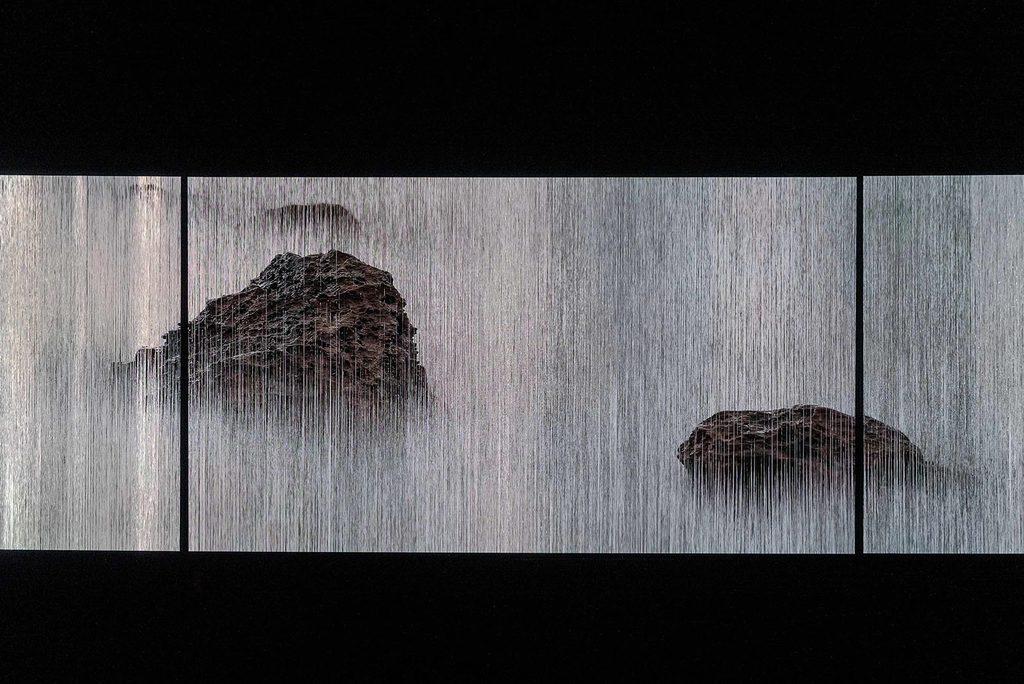
Imeall an chosta, version for the Goethe Institute in Dublin, 2024. Photo by Marcus Maeder
A recent study in Nature Climate Change by the Potsdam Institute warns that the Gulf Stream’s Atlantic Meridional Overturning Circulation (AMOC) — Europe’s climatic “heating powerhouse” — has grown increasingly unstable. Without it, Europe would resemble Canada’s or Siberia’s boreal steppes rather than its current mild, biodiverse latitudes. Researchers around Niklas Boers warn Ireland could face Toronto-like winters as melting Arctic ice alters ocean salinity, weakening the AMOC toward eventual collapse — bringing colder winters, intense storms, and drier summers.
Imeall an chosta (Irish for “Coastline”) scientifically and artistically investigates these climatic changes on West Cork’s coast, focusing on biodiversity in water and on land. Automatic recorders placed across the water-to-land transition capture soundscapes and microclimate data (temperature, humidity, water salinity), analyzed via the Acoustic Complexity Index to track biodiversity dynamics. This eco-acoustic research is paired with artistic exploration, producing formats and concert versions that render these changes tangible. A web radio serves as an acoustic public observatory for Ballydehob/Roaringwater Bay, sparking local dialogue on coastal change.
The web radio interface is used as the central element of the sound installation *Imeall an chosta*, in which visitors navigate through various locations and ecotones and time periods along the West Cork coast and in Roaring Water Bay, allowing them to explore this coastal ecosystem through sound.
Source: Boers, N. (2021). Nature Climate Change, 11(8), 680-688.
Realised at the Crespo Foundation Glenkeen Garden Residency.
Artistic/ecoacoustic research: Marcus Maeder. Scientific advice: Prof. Andrew Wheeler, UCC. Programming: Ken Gubler.
Marcus Maeder is a Swiss sound artist and researcher working at the intersection of ecology, sound, and artistic practice. His work explores soundscapes as a means of perceiving and reflecting on environmental and climatic change, combining field recording, sonification, and acoustic analysis with installation and concert formats. Through projects spanning coastal ecosystems, rivers, and urban environments, Maeder investigates how sound can reveal the hidden dynamics of biodiversity and ecological transformation.