EMAP Workshop: Artistic Case Studies, Practical Experimentation & Collaborative Research In the framework of RIXC Art Science Festival 2026 — Climate Imagination
Friday, 23 October 2026 · 12:00–14:00 (EEST / Riga time) // 11.00–13.00 (CET)
Workshop leader and moderator: Maija Demitere
Invited respondent and working group facilitator: Régine Debatty
Venue: National Library of Latvia, Level 11, Riga
Participation: Open to EMAP members and other interested participants, both onsite and online (hybrid format).
Online participation: To receive the Zoom link, please register via Eventbrite
On Sustainable Digital/Media Art Production
How can digital and media art production become more sustainable? What can we learn from artistic experiments with living systems, environmental data, digital technologies, and collaborative processes?
This EMAP workshop is led by artist and researcher Maija Demitere, whose practice-based doctoral research, “Slow” Media Art and “Deep” Sustainability, investigates how artistic experimentation can contribute to more sustainable relationships between people, technologies, resources, and environments.
Drawing on her research into everyday ecological practices, food production, resource use, waste, DIY technologies, and artistic experimentation, Demitere introduces Slow Media Art and Deep Sustainability as a framework for critically reconsidering the materials, methods, and processes of media art production.
Abstract
From Deep Sustainability to Symbiotic Microbiome
Maija Demitere
How can sustainability become more than a technological solution or a change of materials? How can artistic experimentation transform the ways we live, produce, and relate to our environments?
Developed through her practice-based doctoral research, “Slow” Media Art and “Deep” Sustainability (2024), Maija Demitere’s concept of Deep Sustainability approaches ecological change as a transformation of everyday practices, relationships, and ways of thinking. Through Slow Media Art, artistic experimentation becomes a way to reconsider resource use, technological infrastructures, food production, consumption, waste, and the interconnectedness of human and nonhuman life.
Drawing on Félix Guattari’s The Three Ecologies, this approach takes a transversal perspective, connecting environmental, social, and subjective ecologies across digital and analogue media, technological networks, biological processes, and material practices. Sustainability thus becomes a question not only of what technologies we use, but also of how we produce, connect, and coexist.
Grounded in Bruno Latour’s Down to Earth, human survival requires “learning to land” — shifting from industrial extraction to a grounded, terrestrial attachment to our planet. Combining this with Donna Haraway’s call to “make kin” across multispecies webs, we reject viewing nature as a passive resource. Instead, we practice deep sustainability through slow bio-media art: designing living environments where plants, microbes, and human practices form a self-regenerating ecosystem.
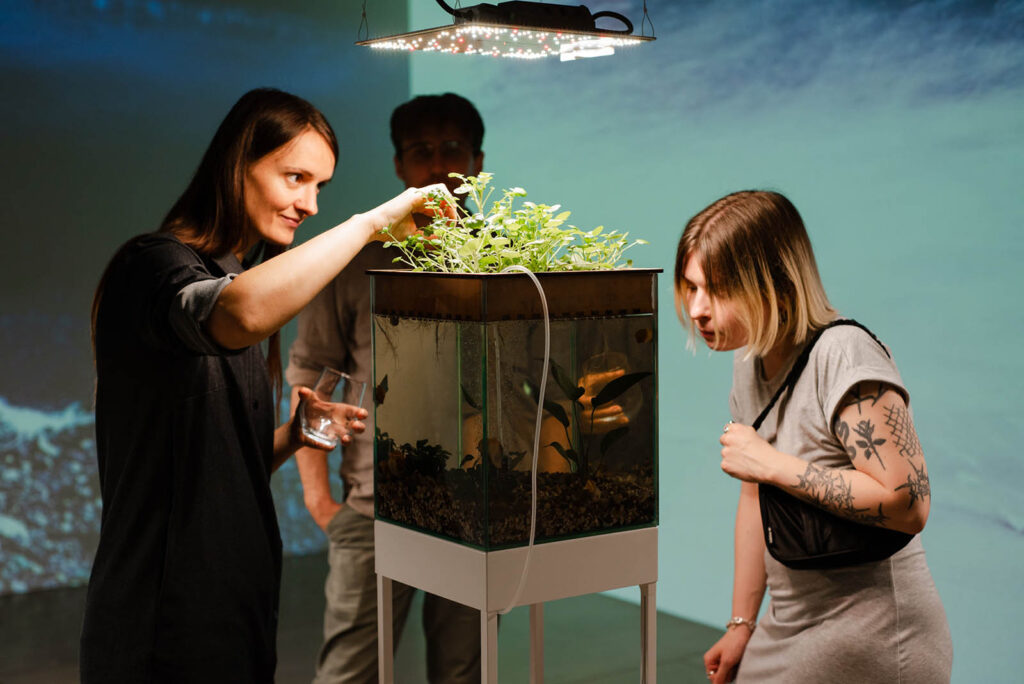
The workshop explores Demitere’s exhibition artwork Symbiotic Microbiome, where plants and root-zone bacteria act as active co-creators, transforming airborne pollutants within interconnected biological processes.
The presentation also revisits earlier artistic experiments and a VR prototype investigating the fragile and damaged ecology of the Baltic Sea, connecting these works to broader questions of sustainable media art production.
Finally, a short demonstration introduces bioplastics made from algae-derived polymers (alginate), embracing hands-on material experimentation as part of a more sustainable way of creating and living.
References
1. Guattari, Félix. (2000). The Three Ecologies. Originally published in French in 1989; English translation by Ian Pindar and Paul Sutton. London: Athlone Press.
2. Latour, Bruno. (2018). Down to Earth: Politics in the New Climatic Regime. Translated by Catherine Porter. Cambridge: Polity Press,.
3. Haraway, Donna J. (2016). Staying with the Trouble: Making Kin in the Chthulucene. Durham: Duke University Press
Workshop Overview and Contributors:
The workshop is structured in two parts: artistic perspectives and critical reflection, followed by practical experimentation and collaborative research.
Part I —
Artistic Perspectives & Critical Reflection begins with Maija Demitere introducing the conceptual framework of Slow Media Art and Deep Sustainability. Three invited artists then present different approaches to artistic production.
Agnieszka (Aga) Pokrywka introduces Green Matter, a feature-length science-fiction documentary developed through her RIXC/EMAP residency, exploring microbial worlds through filmmaking and speculative storytelling. Her wider practice connects fermentation, scientific research, and collaborative artistic processes.
Ryu Furusawa presents Mid Tide #3, an experimental moving-image installation based on long-duration recordings of ocean waves and custom software that transforms video into a spatial structure of time. His practice offers a perspective on technological experimentation, environmental observation, computation, and the ways digital tools shape perception.
Benedikt Terwiel presents Land Before Last, developed in collaboration with ANOHNI, which transforms digital terrain data into a landscape stripped of vegetation and human development, revealing traces of human intervention embedded in the terrain. His contribution opens questions about land use, representation, the the material histories of landscapes, and human memory.
Each artist addresses a shared question:
Where does sustainability enter your artistic production process?
Rather than considering sustainability only as a theme represented by artworks, the workshop examines its relationship to actual artistic production: choices of materials and technologies, computational processes, resource use, experimental methods, collaboration, and the challenges or contradictions involved.
Régine Debatty, writer, curator, critic, and founder of We Make Money Not Art, joins as an invited respondent. Drawing on her extensive engagement with artistic practices at the intersections of art, science, technology, and society, she offers critical reflections on the presentations and introduces questions for the collaborative research.
Part II —
Artistic Experiment & Collaborative Strategies begins with Maija Demitere introducing her exhibition installation Symbiotic Microbiome, which explores relationships between plants, microorganisms, technological systems, and human practices. She follows with a short practical demonstration of bioplastics production using alginate, connecting the conceptual discussion with hands-on material experimentation.
Participants then divide into two parallel working groups, each investigating a different dimension of sustainable digital/media art production:
Group 1 — Bio-materials, Living Systems & Sustainability, facilitated by Maija Demitere, brings together onsite participants to explore material experimentation, living systems, resource awareness, and sustainable production practices.
Group 2 — Digital Technologies, Data & Sustainability, facilitated by Régine Debatty, brings together online and onsite participants to examine digital tools, computational methods, environmental data, technological infrastructures, and the environmental implications of media art production.
Each group works toward identifying two emerging strategies, supported by artistic examples and critical questions.
The workshop concludes with collective reporting and discussion, bringing the four emerging strategies together.
Rather than establishing predetermined categories or universal solutions, the workshop approaches sustainability as an open field of artistic experimentation. Its outcomes will be documented in a practice-based EMAP workshop research report prepared by Maija Demitere, reflecting on the artistic case studies, emerging strategies, their possibilities, limitations, and contradictions.
Participants
Maija Demitere — Latvia; workshop leader, artistic research on Slow Media Art and Deep Sustainability, practical experiment and facilitation of Group 1
Régine Debatty — writer, curator, critic, founder of We Make Money Not Art; invited respondent and facilitator of Group 2
Contributing artists
- Agnieszka (Aga) Pokrywka — Poland / Finland; Green Matter, microbial worlds, filmmaking, fermentation, and collaborative practices
- Ryu Furusawa — Japan; Mid Tide #3, experimental moving image and custom software
- Benedikt Terwiel — Germany; Land Before Last, digital terrain models and environments
Participation: Onsite and online participants are invited to contribute to the presentations and collective research.
Online participation: Remote participants join the working group 2 facilitated by Régine Debatty. To receive the Zoom link, please register via Eventbrite.
Workshop Focus: From Artistic Practices to Emerging Strategies
Common question for artists:
Where does sustainability enter your artistic production process?
Collective research question:
What strategies for sustainable digital/media art production can we identify through different artistic practices?
The four artistic approaches provide initial perspectives for the discussion:
Maija Demitere — Slow Media Art and Deep Sustainability
Living systems, ecological materials, DIY experimentation, digital fabrication, and everyday resource practices.
Agnieszka Pokrywka — Multispecies and Collaborative Production
Microbial research, fermentation, filmmaking, interdisciplinary exchange, and collaborative artistic methods.
Ryu Furusawa — Digital Tools and Temporal Experimentation
Custom software, high-resolution video, prolonged environmental observation, and the relationship between computation and perception.
Benedikt Terwiel — Digital Landscapes
Terrain data, digital representations, and the technological processes through which landscapes can be reconstructed and interpreted.
These are starting perspectives rather than established sustainability strategies. Their relevance, limitations, and potential connections will be examined collectively.
Programme — 12:00–14:00 (onsite and online)
| PART I — Artistic Perspectives & Critical Reflection | ||
| 12:00–12:12 | Maija Demitere — Slow Media Art and Deep Sustainability. Introduction to her practice-based doctoral research, conceptual framework, and the common workshop question. Symbiotic Microbiome and Bioplastics Experiment. Introduction to her exhibition installation and a short practical demonstration using alginate. | |
| 12:12–12:24 | Agnieszka Pokrywka — Green Matter. Microbial worlds, fermentation, speculative documentary filmmaking, and collaborative artistic processes. | |
| 12:24–12:36 | Ryu Furusawa — Mid Tide #3. Experimental moving images, custom software, environmental observation, and computational methods. | |
| 12:36–12:48 | Benedikt Terwiel — Land Before Last. Digital terrain models, environments, landscape transformation, and memory. | |
| 12:48–13:00 | Régine Debatty — Critical Response. Reflections, connections, and questions emerging from the artistic presentations, including challenges and contradictions of sustainable media art production. | |
| 13:00–13:15 | Short Break / Transition to Part II. | |
| PART II — Artistic Experiment & Collaborative Strategies | ||
| 13:15–13:20 | Introduction to Two Working Groups. Maija and Régine introduce the two research directions and expected outcomes. | |
| 13:20–13:45 | Parallel Working Groups. Group 1 (onsite only with experiment) — Maija: Bio-materials, living systems, and sustainable media art production (onsite only). With Ryu Furusawa and others (tbc.), open call participants and the public.Group 2 (online with EMAP participants) — Régine: Digital technologies, environmental data, and sustainable media art production (online and onsite). Each group identifies two emerging strategies. With Agnieszka Pokrywka, Benedikt Terwiel. | |
| 13:45–13:55 | Collective Reporting. Each group presents two emerging strategies, supported by artistic examples and open questions. | |
| 13:55–14:00 | Conclusions — Maija Demitere. Summary of the four emerging strategies and next steps toward the EMAP research report. | |
| 14:00 | Break — Jānis Garančs’s Stereoscopic Installation Demonstration + Snacks.Transition to W3 — On Extending Climate Realities at 14:30. | |
Two Working Groups — Collaborative Research
Group 1 — Bio-materials, Living Systems & Sustainability
Facilitator: Maija Demitere
Participation: Onsite
How can experimentation with biological materials, living systems, and everyday resource practices contribute to more sustainable media art production?
This group builds on Maija’s artistic research, her Symbiotic Microbiome installation and bioplastics demonstration, and Aga Pokrywka’s practice involving fermentation, microbial worlds, and collaborative processes.
Research directions:
- Biological and alternative materials in artistic production.
- Living systems and ecological interdependencies.
- DIY experimentation, resource use, and material life cycles.
- Possibilities and limitations of more regenerative production processes.
Expected outcome: Two emerging strategies, supported by artistic examples and open questions.
Group 2 — Digital Technologies, Data & Sustainability
Facilitator: Régine Debatty
Participation: Online and onsite
How can digital tools, environmental data, computational methods, and technological infrastructures be critically reconsidered in relation to sustainable media art production?
This group draws particularly on Ryu Furusawa’s moving-image experiments and custom software, Benedikt Terwiel’s work with digital terrain models, and the broader questions of technological production raised through the workshop.
Research directions:
- Digital data and computational resources.
- Software, recording technologies, and production choices.
- Technological infrastructures and environmental impacts.
- Artistic experimentation with existing tools, datasets, and systems.
Expected outcome: Two emerging strategies, supported by artistic examples and open questions.
Both groups document their findings in a shared working document for the final discussion and EMAP research report.
Expected Workshop Outcomes — Four Emerging Strategies
The workshop aims to produce a practice-based reflection on sustainable digital/media art production through four artistic perspectives and two collaborative research groups.
The intended outcomes are:
- Four emerging strategies — two developed by each working group, informed by the participating artists’ practices.
- Artistic examples — concrete production methods, materials, technologies, or collaborative approaches that illustrate the strategies.
- Critical questions and contradictions — limitations, uncertainties, and challenges that require further investigation.
- EMAP workshop research report — prepared by Maija Demitere, documenting the artistic presentations, collaborative findings, and possible directions for more sustainable media art production.
The strategies are understood as provisional research outcomes, not universal recommendations. The workshop is intended to open further inquiry into how sustainability can become an active consideration within artistic production.
Biographies
Maija Demitere — Workshop Leader
Maija Demitere is an artist and researcher working within the field of practice-based research, with a focus on ecology and sustainability. Her practice is grounded in experimental inquiry, often long-term and autoethnographic, critically examining processes, systems, and materials related to ecology, food, resource use, waste, and changing landscapes.
Her doctoral research, “Slow” Media Art and “Deep” Sustainability (2024), investigates how artistic experimentation, DIY prototypes, living systems, and everyday practices can contribute to more ecological ways of living and creating. Working across bio-media art, digital technologies, data visualization, and participatory processes, she explores how more connected relationships between humans, technologies, and environments might be imagined and practiced.
Régine Debatty — Invited Respondent
Régine Debatty is a writer, curator, critic, and founder of We Make Money Not Art. She is known for her writings on the intersections of art, science, technology, and social issues, and writes and lectures internationally about how artists, hackers, and designers use technology as a medium for critical discussion.
She created A.I.L. (Artists in Laboratories), a weekly radio programme exploring connections and collaborations between art and science for Resonance104.4 FM in London (2012–2014), and co-authored New Art/Science Affinities (Carnegie Mellon University, 2011). She is an Honorary Fellow of the Royal College of Art in London and a board member of Renewable Futures, an initiative exploring the transformative potential of art in the post-media age.